You cannot copy content of this website, your IP is being recorded
FAQs About Dental Implants

FAQs About Dental Implants

Navigating the journey to a fully restored smile can raise many questions, which is why our comprehensive FAQs about dental implants are designed to provide clear, reassuring answers. By demystifying the implant procedure, Dr. Alireza Moshaverinia, D.D.S., M.S., Ph.D., F.A.C.P., empowers you to make confident, well-informed decisions about investing in your long-term oral health and regaining a beautiful, highly functional smile. For more information, contact us or request an appointment online. We are conveniently located at 5363 Balboa Blvd, #434 Encino, CA 91316.
Navigating the journey to a fully restored smile can raise many questions, which is why our comprehensive FAQs about dental implants are designed to provide clear, reassuring answers. By demystifying the implant procedure, Dr. Alireza Moshaverinia, D.D.S., M.S., Ph.D., F.A.C.P., empowers you to make confident, well-informed decisions about investing in your long-term oral health and regaining a beautiful, highly functional smile. For more information, contact us or request an appointment online. We are conveniently located at 5363 Balboa Blvd, #434 Encino, CA 91316.

Table of Contents:

What exactly is a dental implant, and how does it work?
What are the three main components of a dental implant?
What is the difference between a dental implant and a traditional dental bridge?
Why are dental implants considered the “gold standard” for missing teeth?
How do dental implants prevent bone loss in the jaw?
Am I a good candidate for dental implants?
Is there an age limit for getting dental implants?
Can I get an implant if I have suffered from severe bone loss?
What is a dental bone graft, and will I need one before my implant?
Can I get dental implants if I currently have gum disease?
How does smoking affect my eligibility and success rate for dental implants?
How long does the entire dental implant process take from start to finish?
Is dental implant surgery painful?
What kind of anesthesia or sedation is used during the procedure?
Can I have a failing tooth extracted and an implant placed on the same day?
Can dental implants replace multiple teeth or a full arch? (e.g., All-on-4)
What is the typical recovery time after dental implant surgery?
Will I be walking around without a tooth while the implant heals?
What foods should I avoid immediately after implant placement?
How do I brush, floss, and care for my new dental implant?
Does dental insurance cover the cost of dental implants?
Are there payment plans or financing options available for implant procedures?
How long do dental implants last once they are fully healed?
What is the success rate of dental implants, and what causes them to fail?

What exactly is a dental implant, and how does it work?


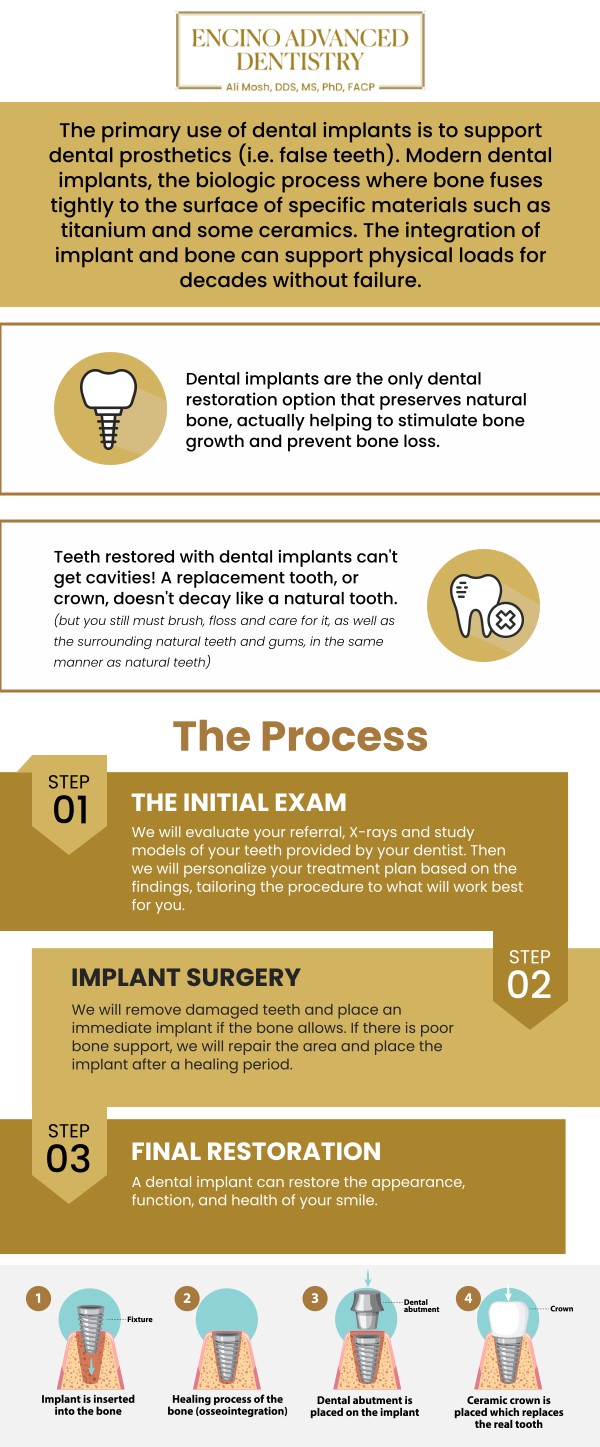
A dental implant is a permanent, artificial tooth root typically made of biocompatible titanium that is surgically placed into your jawbone. Once inserted, it fuses with the surrounding bone in a natural healing process called osseointegration. This creates a remarkably strong and stable foundation that mimics a natural tooth root. After healing, a custom-made replacement tooth is securely attached to the implant, restoring both full function and natural aesthetics to your smile.

What are the three main components of a dental implant?


A complete dental implant restoration consists of three distinct parts. The first is the implant post, which is a titanium screw placed directly into the jawbone to act as the root. The second is the abutment, a small connector piece that sits just above the gumline and attaches tightly to the post. The third component is the crown, the visible, custom-crafted prosthetic tooth that attaches to the abutment for a natural, highly aesthetic look.

What is the difference between a dental implant and a traditional dental bridge?


The primary difference lies in how they are supported. A traditional dental bridge relies on filing down and altering the adjacent healthy teeth to anchor the artificial replacement tooth in place. A dental implant, however, is a standalone solution supported entirely by the jawbone, exactly like a natural tooth. This preserves your surrounding natural teeth from unnecessary enamel removal, makes flossing easier, and provides long-term stimulation to prevent jawbone deterioration.

Why are dental implants considered the “gold standard” for missing teeth?


Dental implants are universally recognized by prosthodontists like Dr. Moshaverinia as the gold standard because they offer the most lifelike, durable, and comprehensive solution for tooth loss. Unlike dentures or traditional bridges, implants stimulate the jawbone directly, halting the bone loss that naturally occurs when a tooth is missing. They restore over 90% of your natural chewing power, do not slip or click when speaking, and can last a lifetime with proper care.

How do dental implants prevent bone loss in the jaw?


When a natural tooth is extracted, the underlying jawbone no longer receives the necessary stimulation from chewing, causing the bone tissue to resorb or melt away over time. Dental implants prevent this deterioration by acting as artificial tooth roots. Once integrated into the jaw, they transfer biting forces directly into the bone, signaling the body to continuously maintain and rebuild bone density in that specific area, effectively preserving your natural facial structure.

Am I a good candidate for dental implants?


Most healthy adults missing one or more teeth are excellent candidates for dental implants. Ideal candidates should have generally good overall health, healthy gum tissues, and sufficient jawbone density to adequately support the titanium post. Even if you have underlying medical conditions like diabetes or high blood pressure, you can usually proceed if these conditions are well-managed. We encourage you to schedule a consultation at Encino Advanced Dentistry to receive a personalized evaluation.

Is there an age limit for getting dental implants?


There is absolutely no upper age limit for receiving dental implants. As long as you are in reasonably good health and can undergo a routine dental extraction, you are likely healthy enough for implant surgery. The only age restriction applies to young patients whose jawbones are still growing—typically, implants are not placed in teenagers or children until facial bone development is completely finalized, which is usually around age eighteen to twenty-one.

Can I get an implant if I have suffered from severe bone loss?


Yes, you can still get dental implants even if you have experienced significant jawbone loss. Thanks to advanced prosthodontic techniques, we can successfully rebuild the foundation using a variety of bone grafting procedures. By restoring the lost bone volume and density first, we can create a strong, reliable base for your future implants. Dr. Alireza Moshaverinia specializes in complex oral rehabilitation, ensuring that bone loss does not permanently disqualify you from achieving a fully restored smile.

What is a dental bone graft, and will I need one before my implant?


A dental bone graft is a highly effective surgical procedure where specialized bone grafting material is added to areas of your jaw where bone density is insufficient. This material encourages your body to regenerate its own natural bone, creating a solid foundation. You will only need one if 3D imaging reveals that your jaw lacks the necessary thickness or height to support an implant securely. Often, minor bone grafting can even be performed simultaneously with implant placement.

Can I get dental implants if I currently have gum disease?


Active periodontal (gum) disease must be fully treated and resolved before moving forward with dental implant surgery. Gum disease causes severe inflammation and destroys the supporting bone and soft tissues, which can easily cause an implant to fail through a condition called peri-implantitis. Once our team effectively manages your periodontal disease and restores your gums to a healthy state, we can safely proceed with planning your dental implant placement.

How does smoking affect my eligibility and success rate for dental implants?


Smoking significantly restricts blood flow to your gums and jawbone, drastically impairing your body’s ability to heal and fight off potential infections. As a result, smokers have a noticeably higher risk of implant failure, slow healing, and post-operative complications compared to non-smokers. While being a smoker does not automatically disqualify you, we strongly recommend quitting or suspending smoking for several weeks before and after surgery to maximize your chances of implant success.

How long does the entire dental implant process take from start to finish?


The timeline varies widely based on individual circumstances, ranging anywhere from a few months to over a year. If no bone grafting is needed, the titanium post is placed and allowed to fuse with the jawbone, taking about three to six months. Afterward, the final custom crown is attached. If extensive bone grafting or pre-treatments are required, the process is naturally extended.

Is dental implant surgery painful?


No, the dental implant surgery itself is not painful. The procedure is performed under local anesthesia, ensuring the targeted area is completely numb. Most of our patients report that the procedure is surprisingly comfortable and less traumatic than a routine tooth extraction. After the anesthesia wears off, it is normal to experience some mild soreness, minor swelling, and tenderness, which can typically be managed easily with over-the-counter pain relievers and ice packs.

What kind of anesthesia or sedation is used during the procedure?


At Encino Advanced Dentistry, your comfort is our absolute priority. For straightforward implant placements, we frequently use a strong local anesthetic to numb the area entirely. For patients who experience dental anxiety or for those undergoing more complex, multiple-implant procedures, we offer various sedation dentistry options. This includes nitrous oxide (laughing gas) or oral conscious sedation to help you remain deeply relaxed, calm, and entirely comfortable throughout your surgical visit.

Can I have a failing tooth extracted and an implant placed on the same day?


In many situations, yes. This streamlined procedure is known as “immediate implant placement.” If your surrounding jawbone is healthy, dense, and completely free of active infection at the extraction site, Dr. Mosh can gently remove the failing natural tooth and immediately insert the titanium implant post during the exact same visit. This drastically reduces the number of surgical appointments needed, minimizes discomfort, and preserves the natural contours of your gum tissue.

Can dental implants replace multiple teeth or a full arch? (e.g., All-on-4)


Absolutely. Dental implants are incredibly versatile. If you are missing several adjacent teeth, an implant-supported bridge can replace them using just two implants. If you are missing an entire upper or lower arch of teeth, we can use the All-on-4 or All-on-6 technique. This involves strategically placing four to six implants to securely hold a full, permanent set of replacement teeth, offering a life-changing, non-removable alternative to traditional dentures.

What is the typical recovery time after dental implant surgery?


Initial recovery from the surgical placement is quite rapid; most patients feel normal and can confidently return to work within one to two days. Minor swelling or bruising usually subsides within a week. However, the internal healing process—where the jawbone physically fuses to the titanium implant (osseointegration)—takes much longer. This vital structural recovery phase occurs beneath the gums and generally requires three to six months to complete before the final crown is placed.

Will I be walking around without a tooth while the implant heals?


You will never have to go without a tooth if you prefer not to. During the months required for the implant post to integrate with your jawbone securely, we can provide a variety of temporary aesthetic solutions. Depending on the location of the missing tooth, options include a temporary dental bridge, a customized clear retainer with a built-in pontic (fake tooth), or a temporary removable partial denture, keeping your smile beautiful throughout the healing phase.

What foods should I avoid immediately after implant placement?


For the first week following your implant surgery, it is crucial to stick to a soft-food diet to avoid irritating the surgical site. We advise avoiding hard, crunchy, sticky, or exceptionally chewy foods (like nuts, hard candies, popcorn, or tough meats). Additionally, stay away from overly hot foods and beverages, as well as spicy items, to prevent unnecessary inflammation. Smoothies, yogurt, mashed potatoes, and scrambled eggs are excellent, safe choices during early recovery.

How do I brush, floss, and care for my new dental implant?


You should care for your new dental implant exactly as you would your natural teeth. Consistent oral hygiene is vital for its long-term success. Brush at least twice daily with a soft-bristled toothbrush and non-abrasive toothpaste, and floss daily to remove plaque around the implant base. Consider using an antimicrobial mouthwash or a water flosser for hard-to-reach areas. Most importantly, maintain regular professional cleanings and checkups at Encino Advanced Dentistry.

Does dental insurance cover the cost of dental implants?


Dental insurance coverage for implants varies dramatically depending entirely on your specific insurance provider and the details of your selected plan. Some insurance policies cover a portion of the implant placement or the final attached crown, while others still classify implants strictly as an elective cosmetic procedure. Our knowledgeable administrative team at Encino Advanced Dentistry is happy to verify your benefits, explain your coverage, and help you maximize your available insurance allowance.

Are there payment plans or financing options available for implant procedures?


Yes, we strongly believe that high-quality, life-changing dental care should be accessible and affordable. Encino Advanced Dentistry offers flexible financing options and partners with trusted third-party financing companies. These flexible plans allow you to divide the total cost of your dental implant treatment into manageable, low-interest, or interest-free monthly payments. Our treatment coordinators will work closely with you to find a financial solution that comfortably fits your personal budget.

How long do dental implants last once they are fully healed?


With diligent at-home oral hygiene and routine professional dental checkups, the titanium implant post itself is designed to be a permanent fixture and can easily last a lifetime. The visible restoration placed on top, such as the porcelain crown or implant-supported denture, experiences daily wear and tear from chewing and speaking. While highly durable, these restorations may eventually need replacement or minor repair after ten to fifteen years of continuous, daily use.

What is the success rate of dental implants, and what causes them to fail?


Dental implants boast an exceptional success rate of up to 95-98%, making them one of the most reliable procedures in all of modern dentistry. In the rare instances where an implant fails, it is usually due to inadequate bone integration, uncontrolled gum disease (peri-implantitis), poor oral hygiene, or heavy smoking. Choosing a highly skilled, Board-Certified Prosthodontist like Dr. Moshaverinia drastically minimizes any risk of failure and ensures the best possible long-term clinical outcome.

At Encino Advanced Dentistry, we understand that dental implants are a significant investment in your oral health and confidence. Dental implants are a durable, long-lasting solution for missing teeth, providing a natural look and feel. Dr. Alireza Moshaverinia, D.D.S., M.S., Ph.D., F.A.C.P., offers personalized consultations to determine if dental implants are right for you. Our team will guide you through the process, which includes implant placement, healing, and the attachment of a custom crown, bridge, or denture. Whether you’re replacing a single tooth or multiple teeth, we ensure a comfortable, efficient treatment plan to restore both the function and aesthetics of your smile. For more information, contact us or request an appointment online. We are conveniently located at 5363 Balboa Blvd, #434 Encino, CA 91316. We serve patients from Encino CA, Tarzana CA, Van Nuys CA, Sherman Oaks CA, Calabasas CA, and surrounding areas.

Check Out Our 5 Star Reviews

Patient Reviews at Encino Advanced Dentistry in Encino, CA


Offers at Encino Advanced Dentistry in Encino, CA


Get Directions to Encino Advanced Dentistry in Encino, CA

5363 Balboa Blvd, #434 Encino, CA 91316.